Sutton Lane Allotment Society
Gardening in the Community
Welcome to the SLAS

The Committee hope you have a fruitful gardening year on the Sutton Lane Allotments.
About Us

Shrewsbury Town Council is the owner of the allotment site situated at the north end of Sutton Lane. Access can also be gained via a narrow pathway leading from Montague Place, and Buttercup Way, which is navigated off Primrose Drive. Shrewsbury Town Council has a ‘statutory’ obligation to provide the land as an allotment site, under the Small Holdings and Allotments Act of 1908, as amended by The Allotments Act 1922 and 1950. The Sutton Lane Allotment Site is recognised by the Local Authority as a ‘statutory’ allotment as defined under Section 8 of the Allotments Act 1925. This means that Shrewsbury Town Council must seek permission from the Secretary of State for communities and Local Government before ‘selling’ or changing the use of the ‘statutory’ allotment site’. The allotments have been in their current location since the 1970’s. The site consists of seventy-nine (79) plots which are made up of full plots, half plots and a limited number of quarter plots. The allotment site is securely fenced and further protected by two locked access gates.
There is a composting toilet (obtained following a successful lottery fund application). Three (3) small car parking spaces, and three (3) community sheds. There are a number of stand pipes and water butts for the express use of plot holders, although water conservation is encouraged. There is a waiting list for plots and this list is maintained by SLAS Membership Secretary.
Sutton Lane Allotments are managed by a committee elected by the members; representatives of the committee (usually Chair and Secretary) liaise when necessary with the Town Clerk and/or Operations Manager of Shrewsbury Town Council.
The SLAS financial year runs from 1st January to 31st December each year; with the Annual General Meeting being held in March. Rents and subscriptions are collected by the treasurer in January of each year. SLAS retains the subscription element.
MEMBERSHIP OF SUTTON LANE ALLOTMENT SOCIETY
A new member will be required to complete a New Member Application Form. Membership subscription is decided at the Annual General Meeting in March each year and is currently £12.50.
The rent per plot is as follows – 2026 (excluding the £12.50 membership fee):
Below are 2026 charges:
Full plot: no concession £57.00
Half plot: no concession £28.50
Quarter plot: no concession £14.25
Full plot: with concession £34.20
Half plot: with concession £17.10
Quarter plot: with concession £8.55
Concessions are for tenants in receipt of state pension.
The age concession relates to members who have reached state retirement age, early retirement does not qualify. Other circumstances may make a concessionary rate applicable (e.g. If a member is registered unemployed), these cases should, in the first instance, be referred to the Treasurer.
All members will receive a membership renewal form annually to be completed, signed and returned with their payment confirming their agreement to abide by the Society’s rules. New members will need to complete this form at the time of joining.
You will be requested to comply with the Rules of the Sutton Lane Allotment Society and you will agree to cultivate and maintain your plot. Whilst it is accepted that not every member has the time to keep their plot in perfect order, all plots should as far as possible, be kept clean, tidy and under cultivation. If you are unable to do this for whatever reason, and you cannot make arrangements for the work to be carried out on your behalf, you should inform the committee in writing so that they can review the situation. If a satisfactory solution cannot be achieved it may be necessary to re-let the plot to someone on the waiting list. The committee has the right to conduct regular plot inspections to ensure that this condition is being adhered to.
A list of current committee members is displayed on the SLAS notice board and on the Your Committee page of this web site. If you have an issue that you would like to be raised, please contact a committee member, who will bring the matter forward for debate at the next committee meeting.
SITE SECURITY
There are no designated public rights of way across the allotment site. The entrance gates and communal storage sheds are secured by means of combination padlocks and key safe system. The combination numbers of these padlocks is known to all members. The committee may change the combination in the future for security reasons. The member is required to secure the entrance gate/s after entering and leaving, by re-scrambling the numbers. The main access gates and all sheds will be kept secure with combination numbers scrambled. Never leave the site or buildings insecure. If unable to secure the site or SLAS building for whatever reason, please contact a committee member who can make arrangements for the site or building to be secured.
SHEDS
If a member wishes to erect a hut, poly-tunnel, shed and /or greenhouse on their plot/s, they must consult the SLAS committee and neighbours before proceeding with its erection. The guidelines are that the proposed structure should be no larger than 6 square metres (a larger structure may be approved following consultation with the SLAS committee). The agreed structure will be sited at least 500mm (1’ 8”) from any path / boundary. The structure must not shade any neighbouring plots and will not have a concrete foundation. In the case of poly-tunnels they will be secured to the ground (Management Policy Document MPD 07 refers).
COMMUNAL SHEDS
Smoking is not permitted in the sheds. There are three communal sheds which are linked. Shed (1) is the main community hut and is of concrete construction and situated in the centre of the allotment site. The shed is used for the storage of members’ tools and gardening accessories. Shed (2) is located at the north end of shed (1) and is also of concrete construction. The shed is used for the storage of SLAS equipment. Shed (3) is attached to the south end of shed (1) It is a wooden shed which is for members communal use.
Shed (3) contains a First Aid kit together with instructions on the reporting of an accident which resulted in injury on the allotment site. Members who use the facilities of Sheds (1) & (2), should ensure that their tools and equipment are clearly marked with their names and plot numbers. The SLAS committee accepts no liability for lost or damaged equipment when stored in these facilities or elsewhere on the site. ‘Wheely’ bins are available in which to store tools.
TOILET
A composting toilet block is provided for members’ use. Instructions on the use of the facility are posted on the walls. Please ensure that you leave the toilet as you would wish to find it. The new member will be shown the location of various access keys during induction. Please lock the facility after use. Smoking is not permitted in the toilet.
STANDPIPES & WATER BUTTS
These are distributed around the site for members to water their plots. All taps are fitted with universal hose connectors to allow hose pipes to be connected to them. The water butts, which are protected with substantial covers, are for the storage of water which is to be used on the plots. Members are requested to ensure the lids on the water butts are replaced to minimise algae growth. Members are also required to replenish any water taken from the butts. The use of hose pipes is allowed. Sprinkler systems or any other attached device to the standpipe will NOT be left on unattended. Water from the standpipe is metered, it is therefore requested that water be used sparingly and where possible use watering cans fed from a water butt this includes conserved water on site. The water will be turned off at the mains during the winter months to prevent damage to the system.
SITE LAWN MOWERS
Two operational lawn mowers are kept secured in a locked shed on the site. A rota of volunteers is prepared the Committee regarding grass cutting of common areas on site. Training is given to the operative prior to the use of a lawn mower. The operative will be informed that ‘Sutton Lane Allotment Society’ has ‘Public Liability and Employer Liability Insurance’ cover, but that ‘Personal Accident Insurance’ cover is their own responsibility. Petrol and oil will be provided from SLAS funds.
GRASS PATHS AND PLOT SURROUNDS
Members are responsible for keeping grass paths around their plots mowed/cut. The committee mowers are not available for this purpose. No barbed wire may be used on the allotment. Pets and dogs are NOT allowed on the allotment site.
COMPOSTING
All members are encouraged to compost as much waste material as possible on site using compost heaps or plastic bins (designed for composting). It is requested that no compostable materials are removed from the allotment site.
MANURE
Details of a local farmer, who delivers manure to the allotment site at plot holders request and expense, are displayed on the communal notice board outside the main shed. Members are encouraged to read the advice in the Notices section on the acquisition of manure to prevent unwanted chemicals being introduced onto the site.
HEALTH & SAFETY
All aspects of site issues concerning Health & Safety are encompassed in Management Policy Document MPD 06.
BONFIRES
Bonfires are permitted on the allotment site between the hours of 1500 and 2000 hours and between the months of 1st October and 31st April. (Please see Management Policy Document 02).
ROYAL HORTICULTURAL SOCIETY
Sutton Lane Allotment Society is an associate member of The Royal Horticultural Society (RHS). The benefits of this body are varied and include organising insurance and providing support in cases of dispute.
NEW SET-ASIDE AREA
The committee is working hard towards achieving a new area of ‘set aside’, which is being developed as an educational and wildlife site containing wild flowers and long grass to support insects, birds, frogs, and mammals. Hopefully, in the future, we will have a peaceful area under the walnut tree where members can sit and enjoy the birds and insects it will hopefully attract. Children, too will be encouraged to take an interest in the area.
Chair
Sutton Lane Allotment Society
Constitution & Rules
Your 2026 Committee
Chair: Viv Canham (Plot 1B)
Treasurer: Terry Edwards (Plot 7B): terryedwards@talktalk.net
Secretary: Richard Tither (Plot 33A): secretarysuttonlane@gmail.com
Membership: Di Davis (Plot 19B): Membership Secretary
Health & Safety & First Aid Advisor: T.B.C.
Newsletter: Clare Ardill (Plot 8B)
Maintenance: Ron Milner: (Plot 24A)
Roy Ellis (Plot 37A/38A)
Anna Clements (Plot 19A)
Darren Hilton (Plot 29)

Contact Us
- Sutton Lane, Shrewsbury, UK
- Sutton Lane, Shrewsbury, Shropshire
Newsletters


 #
#


 Image caption
NOVEMBER 2019 NEWSLETTER

Membership Category Definitions (MPD 01)

Membership Category Definitions
To be read in conjunction with Clause 5 of the SLAS Constitution and Rules as amended at the 2017 AGM.
1) A Member
Shall consist of an Allotment and/or Leisure Gardener or such other persons as the management committee may admit, living or working within the town of Shrewsbury and thereby eligible to hold a plot on the Societies site.
Note; on joining the Society a ‘twelve-month probationary period’ will apply for all new members to enable the committee to establish whether the new member is able to cultivate the plot. A Member may hold a maximum of a single plot or two half plots (not retrospective).
Members are required to inform the committee of the names of anyone assisting them with the cultivation of their plot who will be known as non-voting members of the Society. The committee will keep a record of all such helpers to ensure the Society meets the requirements of its insurance policy. Members must ensure that anyone assisting them with the cultivation of their plot complies with the Society's Rules while on the site.
2) An Honorary Member
Shall be a member who by their longstanding commitment to the SLAS, be invited by the Chairman to be made an Honorary Member. The invitation will be at the discretion of the Chairman, seconded by a committee member and approved by the committee. Once approved the Honorary member will not be required to pay membership fees or plot rental charges during their remaining period of membership of the Society but in all other respects will adhere to and be governed by the Constitution and Rules of the Society. The costs of the membership and plot tenure will be met by the Society.
3) A Social Member
Shall be an existing member who wishes to remain a member of the Society but withdraw from allotment cultivation responsibilities. Social members will adhere to and be governed by the Constitution and Rules of the Society subject to the relaxation of any clause requiring cultivation of a plot. The management committee shall consider the application and if approved, shall confirm the Social Member status and amend its records accordingly and re-allocate the member’s plot. A social member will be required to pay Society membership fees only. A social member wishing to resume allotment cultivation shall be placed on the ‘internal’ membership waiting list and be allocated a plot in accordance with the general management process of plot allocations.
Bonfire Management (MPD 02)

To be read in conjunction with Clause 12.13 of the SLAS Constitution and Rules as amended at the 2017 AGM.
Bonfire Management Procedures
- Bonfires will be permitted to be set between the months 1st October and 31st April.
- Bonfires will only be set between the hours of 15.00 hrs and 20.00 hrs.
- Bonfires will be located at the centre of a member’s plot to maximize the distance between the fire and an adjoining member’s plot or structures.
- Bonfires must always be attended by the member and be accompanied by suitable equipment to extinguish the fire should it become a hazard to the adjacent plots.
- Bonfires should only be set using materials found on the members plot, bringing materials to site to burn is not permitted.
- Bonfires must not be set in high winds i.e. winds over 15 knots or Force 4 on the Beaufort scale (information available on most weather forecasting apps).
- Bonfires to be set in incinerators to protect wildlife.
Complaints & Appeals Procedure (MPD 03)

To be read in conjunction with Clause 12.21 of the SLAS Constitution and Rules as amended at the 2017 AGM.
1) Introduction
1.1 The SLAS Management Committee hope that you won’t ever be made to feel upset or annoyed by our or our members’ behaviour whilst you are at your allotment. We want to make sure that, if you do need to raise concerns about anything, it will be dealt with properly and in accordance with our Constitution and Rules. The SLAS Management Committee has an established process for you to follow as outlined below to make sure that your complaint is dealt with fairly, promptly and resolved to everyone’s satisfaction as quickly as possible.
2) Informal complaints
2.1 Informal complaints should be made verbally to a SLAS Management Committee Member. Should the complaint be simple i.e. resolved by a review of the Constitution and Rules it will be dealt with straight away by the SLAS Management Committee Member who will take the appropriate action on your behalf and report back to the SLAS Management Committee at the next available meeting date. If the nature of the complaint is more serious, and you believe that the above noted resolution of the complaint does not meet with your satisfaction thus requiring the review of the SLAS Management Committee you will be asked to put your complaint in writing and it will be dealt with as a formal complaint as outlined below.
3) Formal Complaints
3.1 If you are unhappy about any aspect of the way the site is being managed, or if you have a complaint about the way you have been treated, please contact in writing the SLAS Secretary with full details of the complaint. The SLAS Chairperson will then respond to you within 10 working days, setting out how your complaint will be investigated. You will also be given the name of the person undertaking the investigation. After the investigation, the SLAS Management Committee will discuss the matter at their next Committee Meeting and will then write to you within 10 working days of the meeting with their decision summarising their actions to remedy the complaint and their reasons for this action. If the SLAS Management Committee require longer to resolve the matter they will explain to you why it might take longer. Should the complaint relate directly to the behavior of a SLAS Management Committee member, that member will be excluded from the process to ensure impartiality of the process and any decisions made. Once the review process is concluded the SLAS Management Committee will respond to the complainant in writing with their decision, actions and recommendations.
The Committee's decision will be final.
Equal Opportunities Policy (MPD 05)
To be read in conjunction with Clause 14 of the SLAS Constitution and Rules as amended at the 2017 AGM.
Sutton Lane Allotment Society recognises that every member has a contribution to make to the Society and the right to an equal opportunity to make their contribution.
1) No member or related agency will be discriminated against by us on the grounds of:
- gender (including sex, marriage, gender re-assignment);
- race (including ethnic origin, colour, nationality and national origin);
- disability;
- sexual orientation;
- marriage and civil partnership
- pregnancy and maternity
- religion or belief;
- age.
- Opposing all forms of unlawful and unfair discrimination.
- All members and related agencies will be treated fairly and with respect.
- Membership will be open to all.
- Selection for volunteering or any other benefit will be on the basis of aptitude and ability. All selection/rejection decisions will be recorded.
- All members will be helped and encouraged to develop their full potential. The talents and resources of individuals will be fully utilised to maximise the benefits to the Society.
- All members have a legal and moral obligation not to discriminate and to report any incidents of discrimination against any individual or group of members to a member of the management Committee.
- To create an environment in which individual differences and the contributions of all our members and related agencies are recognised and valued.
- Every member and related agency are entitled to be part of an environment that promotes dignity and respect to all. No form of intimidation, bullying or harassment will be tolerated.
- Breaches of this Equality Policy could lead to membership disqualification.
- This policy is fully supported by the Society's Committee and has been agreed by the membership at the Annual General Meeting of the Society.
- The policy will be monitored and reviewed annually.
- The successful implementation of this policy depends on the awareness and commitment of all members.
Health & Safety Policy (MPD 06)
To be read in conjunction with Clause 15.1 of the SLAS Constitution and Rules as amended at the 2017 AGM.
1) Introduction
1.1 All activities carry an element of risk and allotment gardening is no exception. Everyone needs to take health and safety seriously, but it is also very important for plot holders not to become "litigation paranoid" and to approach the issue sensibly.
1.2 New and existing plot holders have a responsibility (duty of care) to anyone on their plot, regardless of whether they have given permission for them to be there. Plot holders should act responsibly and comply with any health and safety rules and any information communicated by the allotment committee.
1.3 New plot holders will be advised about any ongoing health and safety risks or hazards on the allotment site at the time of taking on the plot and upon signing the membership documentation. Existing plot holders have a duty of care to ensure risks and hazards are identified and minimised during their tenancy.
2) Report hazards and concerns
2.1 Plot holders should report concerns about health and safety on their plot or the site to the Committee as soon as they occur. Committee members contact details can be found displayed on the Site Notice Board. You should also let any visitors to your plot know about any ongoing health and safety issues you are aware of. If a plot holder plans to spend long periods of time alone on their plot, they should let someone know and consider advising the membership secretary of emergency contact details.
3) Ponds/Water Butts
3.1 It is acknowledged that small ponds/pools on allotments attract beneficial wildlife to the surrounding areas. It is imperative that if members construct small ponds on their plots that these should always be covered with wire meshing to avoid the hazard of members' children falling into the water. At the same time, members must ensure that children are kept under constant control and within eyesight of the responsible adult/parent
4) Vandalism
4.1 In order to reduce the risk of vandalism, the Committee will ensure that adequate security measures are in place and that plot holders know how to use them. Plot holders should ensure that gates are always locked and always report instances of vandalism to the police and obtain an incident number, as well as informing the allotment Committee of the incident.
5) Chemical Hazards
5.1 Cutting down chemical use; Plot holders have a duty of care to store, use and dispose of herbicides, pesticides and fertilisers properly. This includes weed killers, rat poisons, fungicides and soil sterilants. Herbicides/pesticides should never be decanted into any other container. They should always be stored well out of reach of children, clearly labelled and locked away.
5.2 Disposal of herbicides, pesticides and fertilisers; Plot holders should contact their council waste management department for information about facilities for the safe disposal of surplus herbicides, pesticides and fertilisers. Herbicides/pesticides should never be included in household rubbish, burnt, placed in skips or poured into any kind of drainage system or watercourse.
6) Duties of the Committee
6.1 The committee will carry out regular Health & Safety inspections of the allotments and buildings and will contact members outlining any areas of concern. If required, the member should take remedial action without delay and inform the committee upon completion of their remedial action.
Health & safety
Health & Safety on an allotment site is of paramount importance. Hazards and risks can be found everywhere - including the plants!
Here is a case in point. This reaction was caused by parsnip sap, reacting on the skin. Gloves are a must!

Temporary Structures Policy (MPD 07)
Temporary Structures
To be read in conjunction with Clause 12.11 of the SLAS Constitution and Rules. Effective from 1st April 2017 subject to agreement of the membership at the AGM 2017.
This document identifies the rules for the sizing and placement of temporary structures on a member’s allotment plot.
A temporary structure (TS) is a semi-permanent structure over 4 feet high. A plot holder is allowed to erect two structures on their allotment providing that they follow the following rules.
- The TS covers 6 square meters or less.
- The TS is 0.5m or more from all boundaries including fences.
- The TS does not shade neighbouring cultivated land or allotments.
- The plot holder informs the SLAS committee via mail or email and receives written confirmation that the TS is permitted within the rules before erection starts, the request must include length, width and height and indicate clearly, it’s proposed location preferably via a simple plan.
- Verbal communication with committee members does not constitute permission to proceed.
- The committee may consult with neighbours before responding, it is advisable where possible that they are consulted by the plot holder.
A TS that exceeds these dimensions or requirements may still be permitted but will be voted upon by the full committee and permission may take longer, the committee will always seek to allow a TS but will refuse or require modification of size or location to protect walkways or neighbours from obstruction or shade.
All structures and surface cladding must be securely affixed to adequate foundations to ensure stability, fixation to the ground and resistant to wind forces. No permanent poured concrete foundations are permitted.
The plot holder must not exceed the permission granted, any structure that does not conform to the permission will be required to be removed or altered so that it conforms; if during TS erection it becomes clear that deviation is needed, the plot holder must cease erection and seek advice in writing ASAP.
Quarter Plots
Sheds are prohibited on quarter plots, however greenhouses are allowed subject to committee approval and compliance with the above.
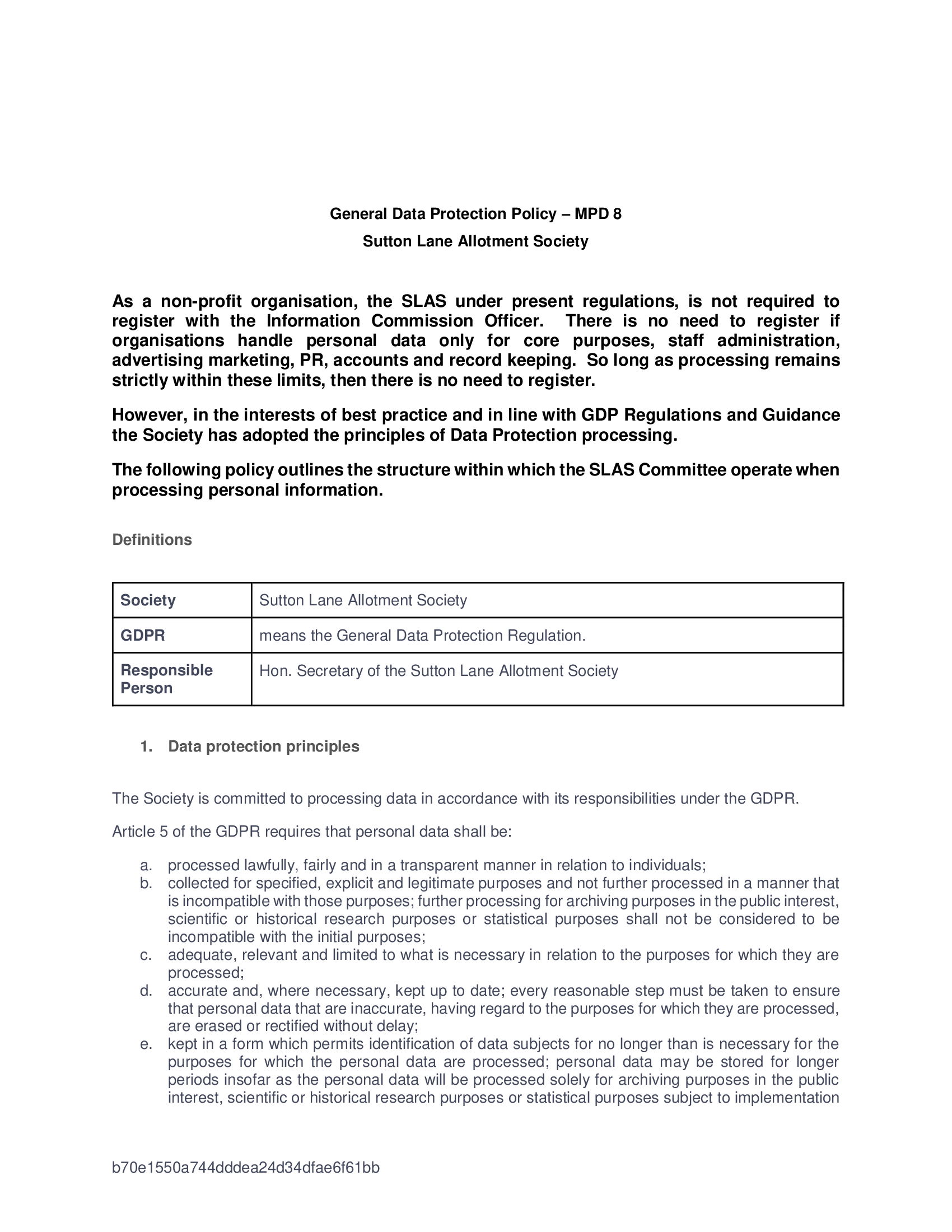
Data Protection policy - MPD08


CODE OF CONDUCT - mPD 09
.

Notice Board & Sponsorship
Shrewsbury in Bloom 2022
The Mayor of Shrewsbury was delighted to honour the town’s top gardeners in the Town Council’s annual Town of Flowers Awards.
Residents and businesses were invited to the Mayor’s Parlour at Riggs Hall for an awards presentation to honour the winners of this year’s contest.
Competitors were judged in a range of categories including best residential large and small front gardens, best floral container, and best commercial premises.
Entries were judged in July by members of the Shrewsbury in Bloom Group.
After much deliberation, the judges declared Mr J Evans a member of the Sutton Lane Allotment Society and ex. Committee member, the winner of the Large Garden category.
John Evans accepting his well-deserved trophy from the Mayor of Shrewsbury, Councillor Elisabeth Roberts

SLAS SOCIAL EVENT AND TROPHY PRESENTATION 2022
The SLAS held a very successful afternoon at the Reabrook Social Club on Sunday, 9th October 2022 where we were able to recognise the winners of the best plots for 2022. Attendance was good and a superb buffet was provided courtesy of Greggs and ably put together by Belinda Pugh and her team (thank you Belinda). The bar was open, and members enjoyed their food along with drinks of their choice.
A best colouring in competition was held for our younger family members and the standard was so high, all participants won a prize!
James Tomley very kindly allowed us to use his pumpkin for the ‘Guess the Weight of the Pumpkin’ Competition, which was won my Roy Ellis, who very kindly re-donated his winnings toward Society funds – thank you Roy.
The three competition categories were: Best Plot; Best Half Plot and Best Newcomer’s Plot. The standard was high this year and an objective scoring system was used to ensure fairness. Trophies were kindly presented by our Vice Chairman, Mark Pugh.
The Committee would like to congratulate the following members:
Best Plot – Mr Ron Milner (who also carries out the maintenance of the site)

Best Half-Plot – Mr Richard Tither
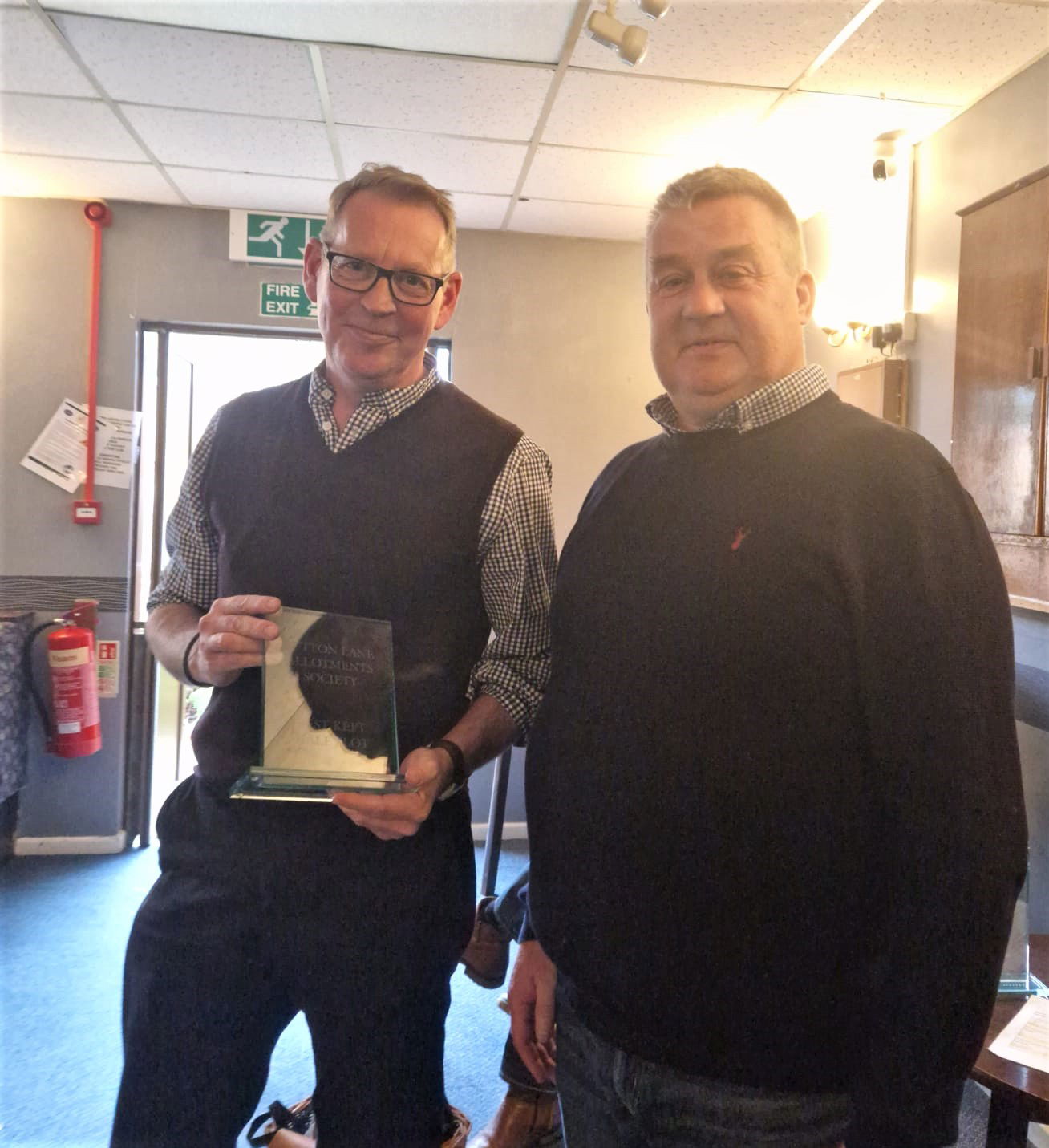
Best Newcomer – Mr Tom Cave

Special thanks go to everyone who helped to make the afternoon an enjoyable social event and hopefully, this format can be built on and improved year on year.
Last but not least, our sincere thanks are also extended to the staff of the Reabrook Social Club who were wonderful on the day.
Liz Lowe
Secretary for the Sutton Lane Allotment Society

_______________________________________________________________________________
Sutton Lane Allotment
Management Policy Document 10
Advice on the Acquisition of Manure
Introduction
Problems surrounding contaminated manure are, once again, being reported. A herbicide called aminopyralid is the main substance for concern and has contaminated many common organic substances like compost, hay, manure, and straw in the past and increased incidences are being reported again.
Aminopyralid is a herbicide often used in pastures and wheat fields, which damages or kills most plants except grasses. This chemical takes years to break down and doesn’t break down in composting. While aminopyralid is in the soil, many common garden plants will not grow or produce well, if at all.
The only way to avoid aminopyralids is to only use compost, manure, from your own plot, or test whatever supplies you buy.
Test for Aminopyralids
Crops that are particularly susceptible to aminopyralids are potatoes, tomatoes, peas and beans, others like brassicas or corn seem unaffected. The symptoms can vary depending on the concentration in the manure and include stunted growth, chlorosis, brown leaf margins or curled leaves.
If you are concerned about a batch of manure, you can do a test by mixing with some compost (which you know to be good) and sowing some broad beans or peas in pots. Do a couple of pots with and without the manure added to compare the results. If you have a problem, you should notice it in 2-3 weeks and see distorted growth, there will be a marked difference to those grown in the clean compost.
If you need to remove manure from problem beds or if you need to dispose of effected manure or compost, you should not add it to your compost heap as the problem will persist. The same goes for any foliage or prunings from affected plants. Contaminated manure should be removed from site and disposed of elsewhere.
However, notwithstanding the above, it is far better to avoid purchasing contaminated material in the first place.
SLAS Position
Shrewsbury Council are encouraging all allotment sites within the area to take measures to mitigate the possibility of introducing contaminated supplies onto our Allotment sites and the best way is to ask for written certification from your supplier that the material is free from all pesticides – organic or otherwise.
The best thing you can do is to produce your own compost as you know where the material going into it has come from. However, it is acknowledged that it’s not always feasible to produce enough composted material for the whole plot in this way.
Members are therefore asked to remain alert to the situation and wherever possible, endeavour to ensure externally sourced manure is clean and uncontaminated by acquiring certification to this effect from the supplier.
THE SPRAYING OF PATHS IS NOT ALLOWED.
ANY SPRAYING OF PLOTS SHOULD BE IN CALM CONDITIONS AND NEIGHBOURING PLOT HOLDERS NOTIFIED PRIOR TO OPERATION. A LAMINATED NOTICE SHOULD BE DISPLAYED ON THE PLOT. DETAILS OF CHEMICAL USED AND THE DATE OF SPRAYING PLACED IN THE SPRAY BOOK LOCATED IN THE COMMUNITY SHED.
THANK YOU.

SUTTON LANE ALLOTMENT SOCIETY
NOTICE TO MEMBERS
USE OF ROTAVATOR
The Society has recently acquired a rotavator for Members' use. A logbook is located near the Rotavator situated in the shed which should be filled in each time the machine is to be used.
A few do's and don'ts need to be heeded to ensure the Society gets years of service from this machine.
- Before use, all details must be entered into the logbook prior to taking the rotavator, this can be found behind the grid on the wall - please replace once used.
- Petrol is not supplied by the Society and must be provided by the member using the machine.
- Please ensure the rotavator is as clean as possible after use to avoid mud and dirt on the shed floor
- Any issues must be reported to Mark Pugh (Vice Chair) or Ron Milner (Maintenance), (or any member of the Committee in the event they cannot be reached)
- Use of this machine is entirely at the member's own risk and the Society does not accept any liability/responsibility in the event of injury or harm to the member or any possessions/equipment.
Secretary
For & on behalf of SLAS Committee
Helpful Videos
We will place some helpful videos on this page for members new to gardening offering helpful hints and tips. If any of our members have any links that they feel might be useful to other members, please forward for inclusion.
- Charles Dowding - Making Compost from Garden and other wastes: https://www.youtube.com/watch?v=Kf6CGj7xpFE
- Charles Dowding - How to Grow Lettuce: https://www.youtube.com/watch?v=_pgcvN6TuE8
- Crop Protection for Early Spring Plantings: https://www.youtube.com/watch?v=qDKLn3UIYUc
- Charles Dowding - How to Grow Spinach: https://www.youtube.com/watch?v=fE59HrNodZY
- Tony O'Neal - UK Here we Grow (How to grow sweet potatoes): https://www.youtube.com/watch?v=txDcKo6MBzw
- A Gardener's Guide: Composting: https://www.youtube.com/watch?v=RKl2hJdMqfg
- Beechgrove Repotted 7: Community Allotments: https://www.bbc.co.uk/iplayer/episode/m000dwsk/beechgrove-beechgrove-repotted-7-community-allotments
- Mr Smith's Vegetable Garden (wonderful advice for beginners): https://www.youtube.com/watch?v=uFTi2F1N7y4
::
Losing the Plot! (An every day story of ingenuity and determination)! Roy & Cathy's Story Plot 37A
Gallery

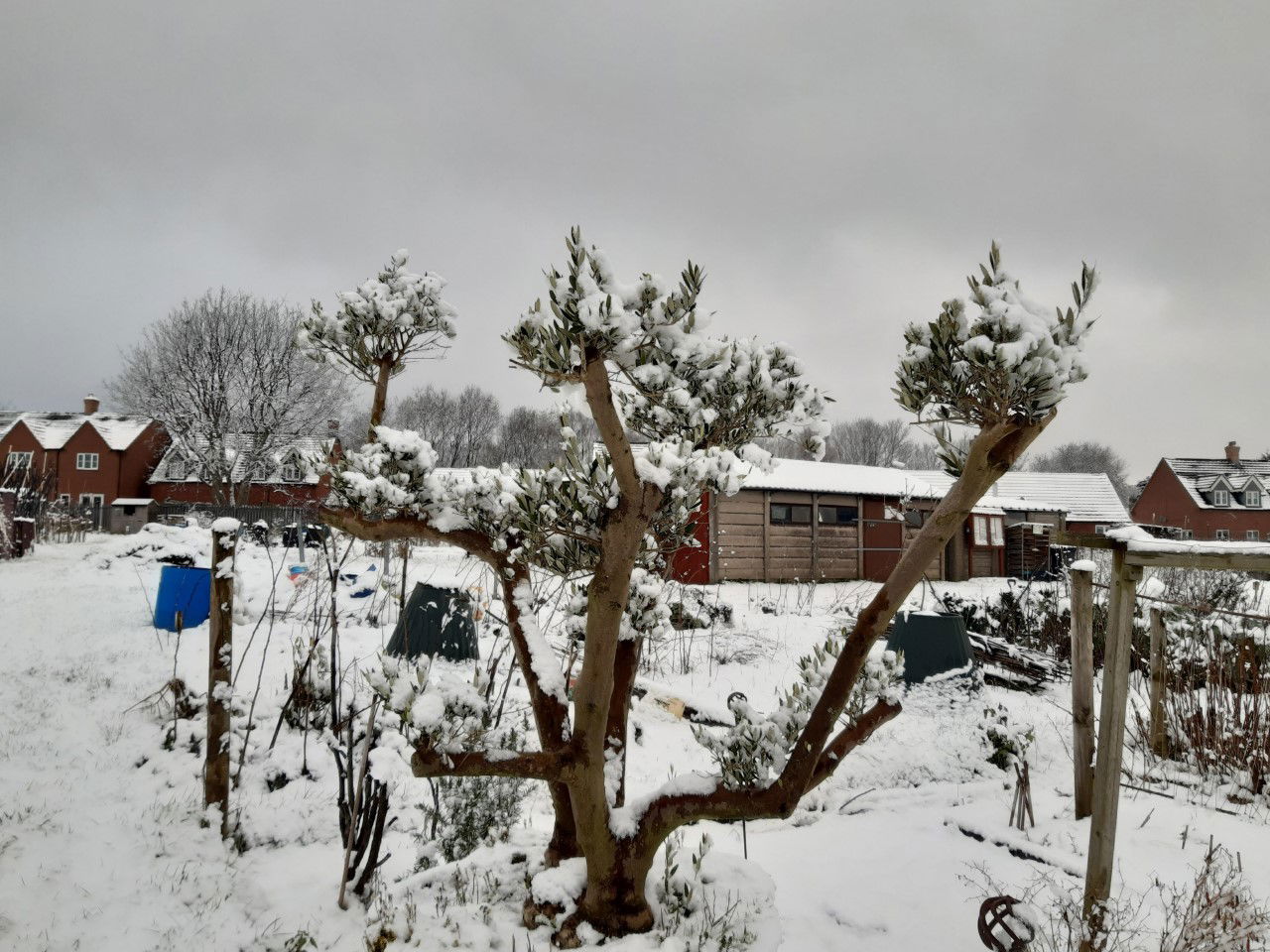


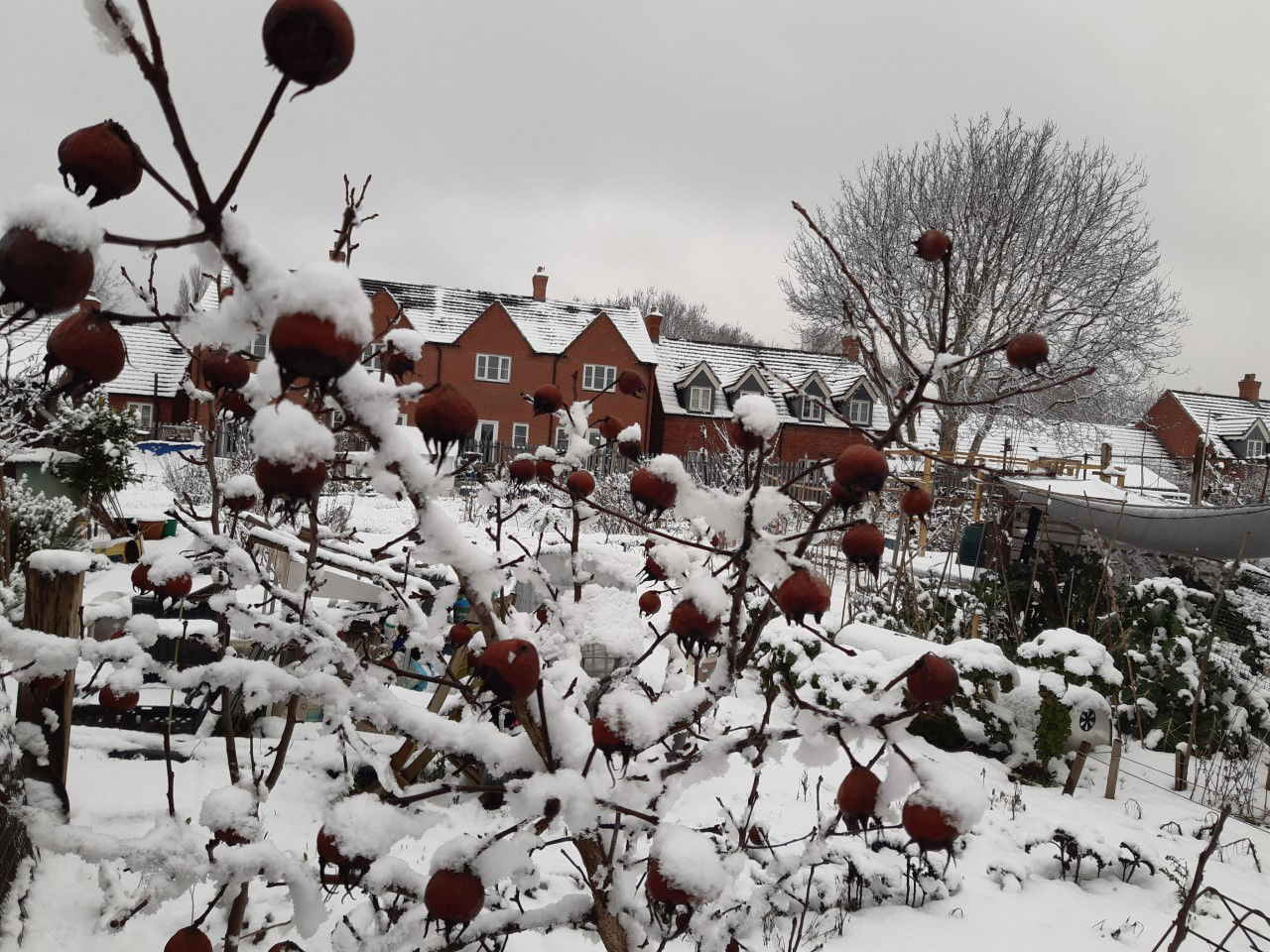


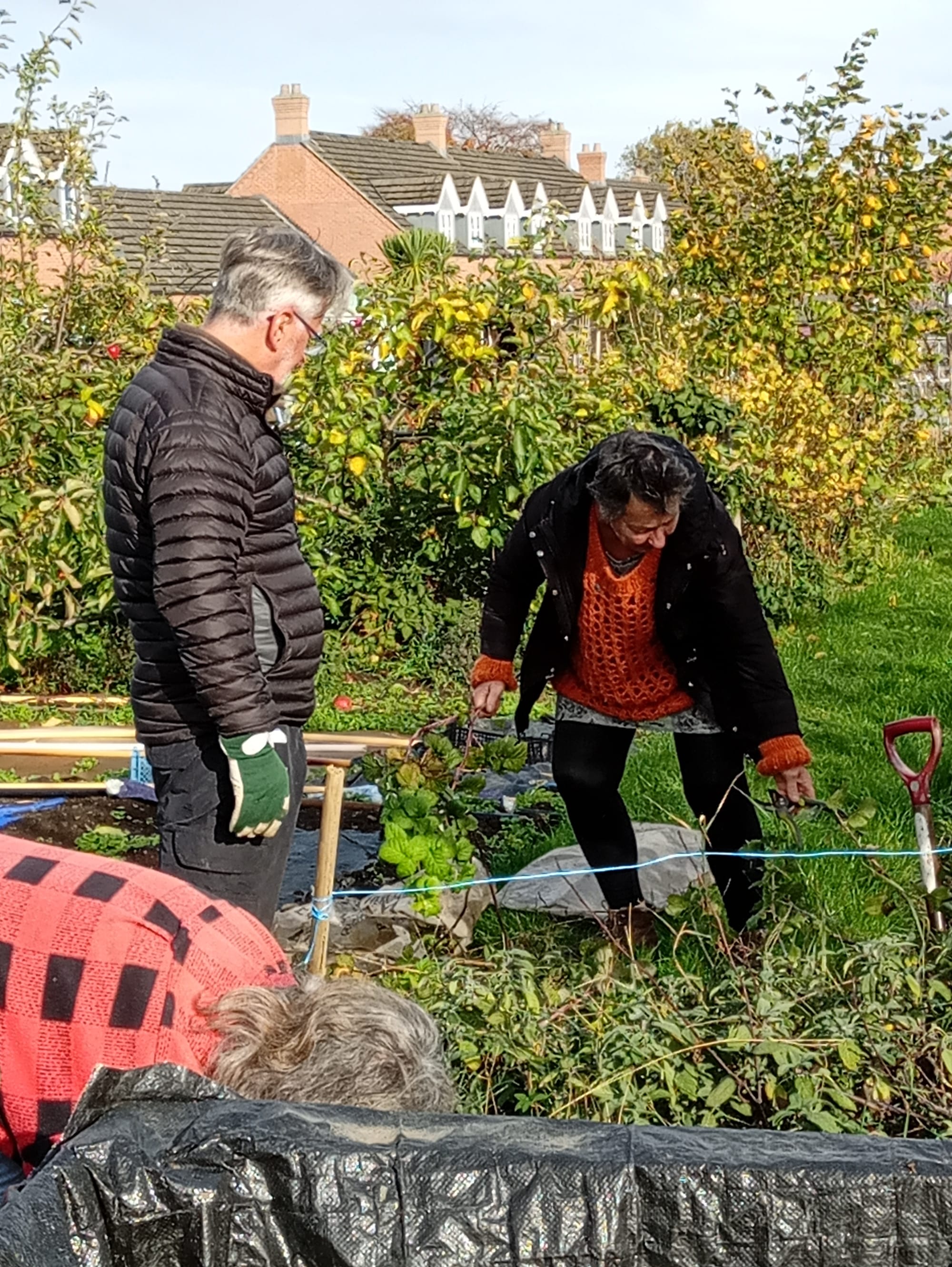
Ben's Pumpkin!


Articles
Organic gardening - the way forward
The following article was kindly written by Sheila Jones, a long-standing member of the Sutton Lane Allotment Society. The objective is to raise awareness of the many benefits of gardening organically, and we therefore look forward to receiving contributions from Sheila for inclusion on our website and future newsletters. Liz Lowe: SLAS Chair
ORGANIC GARDENING WORKS WITH NATURE NOT AGAINST IT
The RHS describes organic gardening as a ‘system which makes minimal use of manufactured chemical substances. These are elements of a philosophy which takes a holistic view of gardening, emphasising the interdependence of life forms.’ Gardening establishes a contact with living things. Gardens and allotments are increasingly important to us, for our mental and physical well-being, and to the wildlife which depends on us, as a connected habitat in an increasingly fragmented landscape.
- ORGANIC RECIPES CAN PROVIDE AN ALTERNATIVE TO PESTICIDES (WHICH INCLUDES HERBICIDES & FUNGICIDES)
Garlic spray can be used against slugs, aphids, and lily beetles - there are different recipes, but basically it is crushed cloves of garlic in boiled water, strained, watered down and used regularly as a spray. A tea tree spray can be used against mildew and black spot. Companion planting can be a deterrent against aphids (nasturtiums and wormwood) whitefly (French marigolds) and carrot fly (alliums) Marigolds (calendula), can attract a lot of beneficial insects.
- USE NATURAL ALTERNATIVES TO METALDEHYDE SLUG PELLETS - NOW BANNED FROM SALE
These can kill birds and hedgehogs indiscriminately. Any leftover pellets can be taken to the tip to dispose of safely. Instead, use sheep’s wool, beer traps, garlic spray, nematodes, or cut off plastic bottles as protectors, also, a torch at night!
- PERNICIOUS WEEDS CAN BE SUPPRESSED USING A MULCH INSTEAD OF A GLYPHOSATE WEEDKILLER (ROUNDUP)
Lay a mulch of cardboard or thick layers of newspapers topped with a thick layer of compost, manure, spent mushroom compost or bark chips for 1 year minimum, and plant into it.
- USE NATURAL FERTILISERS INSTEAD OF CHEMICAL FERTILISERS
Chicken fertiliser, blood fish and bone, bone-meal, and homemade comfrey tea are all really good natural fertilisers. Comfrey tea is made by filling a bucket with comfrey leaves (very high in nitrogen, phosphorus, and potassium) top up with water, covered, as it is very smelly and use after 3 weeks. Strain, and use watered down well. Nettle leaves (high in nitrogen) also make very good fertiliser.
- AVOID USING PEAT, AS DIGGING IT UP REMOVES A VERY VALUABLE HABITAT AND CONTRIBUTES HUGELY TO CO2 EMISSIONS.
Peat free composts MUST BE LESS THAN 6 MONTHS OLD AND NEVER HAVE GOT WET AT ANY STAGE. Peat based composts are due to be phased out at the end of 2024. Look out for plants grown in peat free compost, and organic seeds.
- ENCOURAGE BENEFICIAL WILDLIFE WHICH WILL POLLINATE YOUR VEGETABLES AND EAT YOUR SLUGS AND APHIDS ETC BY CREATING HABITAT PILES
Piles of wood, twigs, stones etc in an undisturbed corner can provide a habitat for frogs, insects, hedgehogs etc. An old recycling box with a CD cover size hole cut in the front makes an ideal hedgehog box. Water, even if only a plant pot saucer, will also attract birds and insects to your plot.
Sheila Jones May 2023
CROP PLANNER -

our new wildlife area
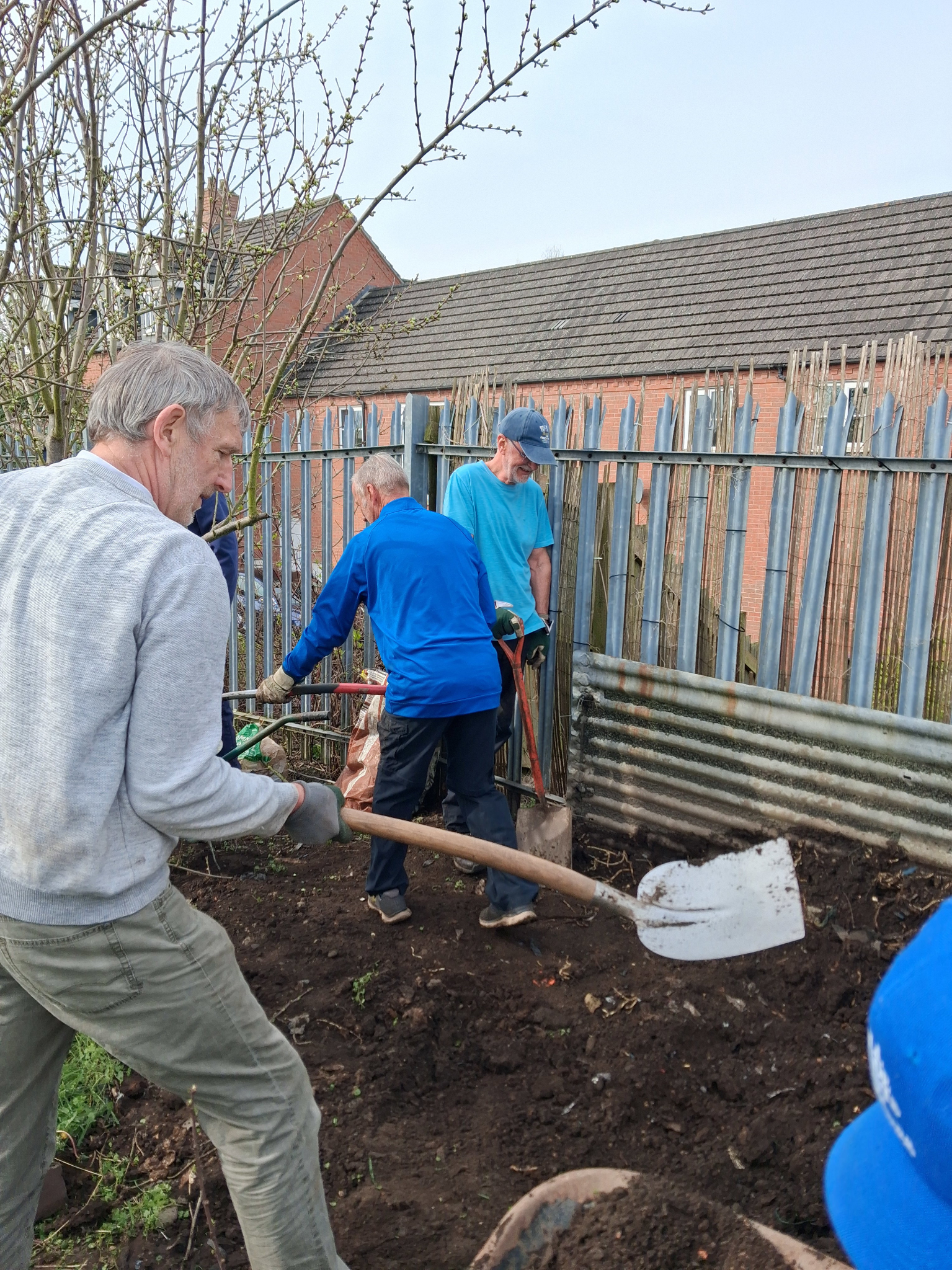
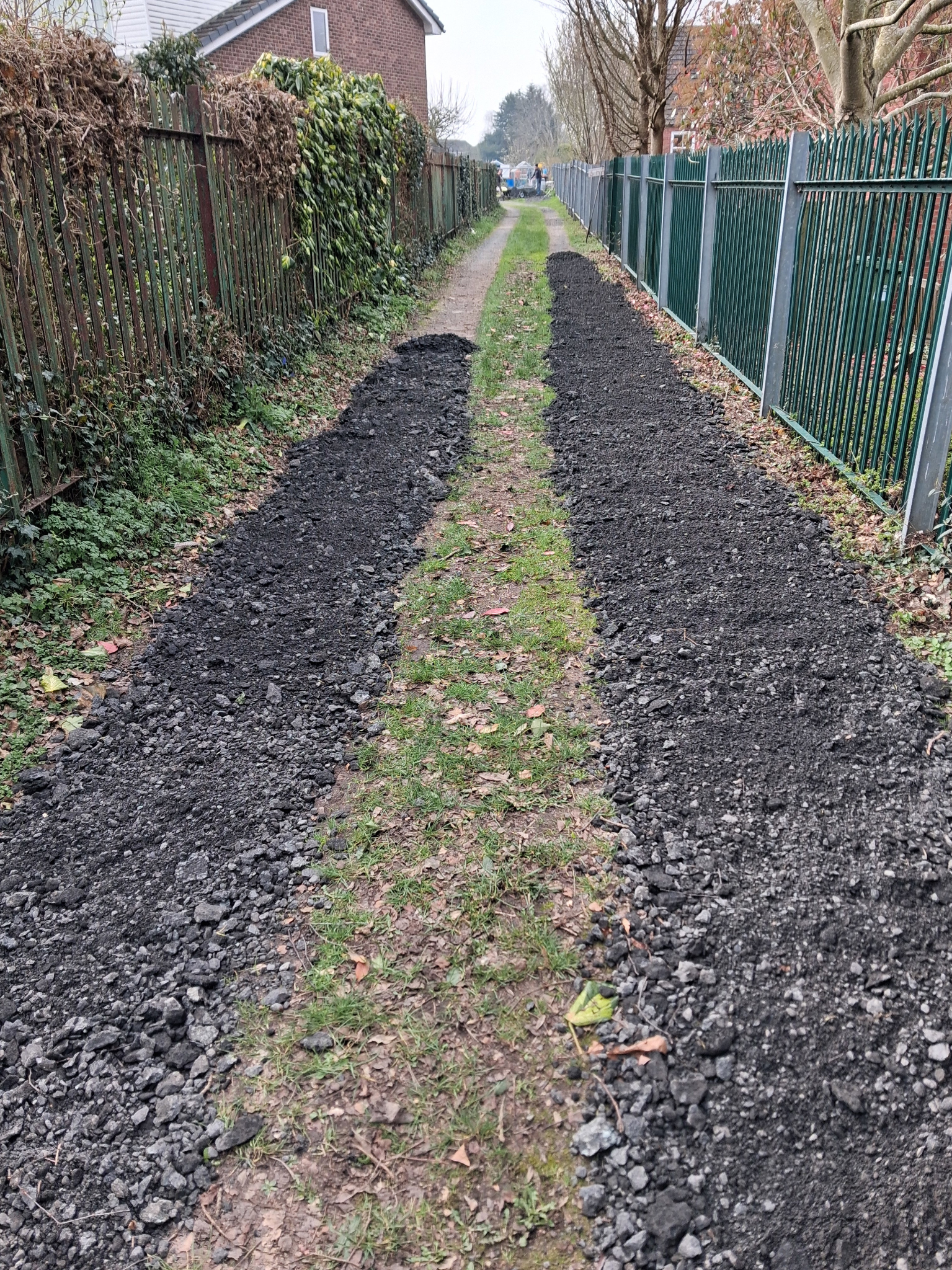
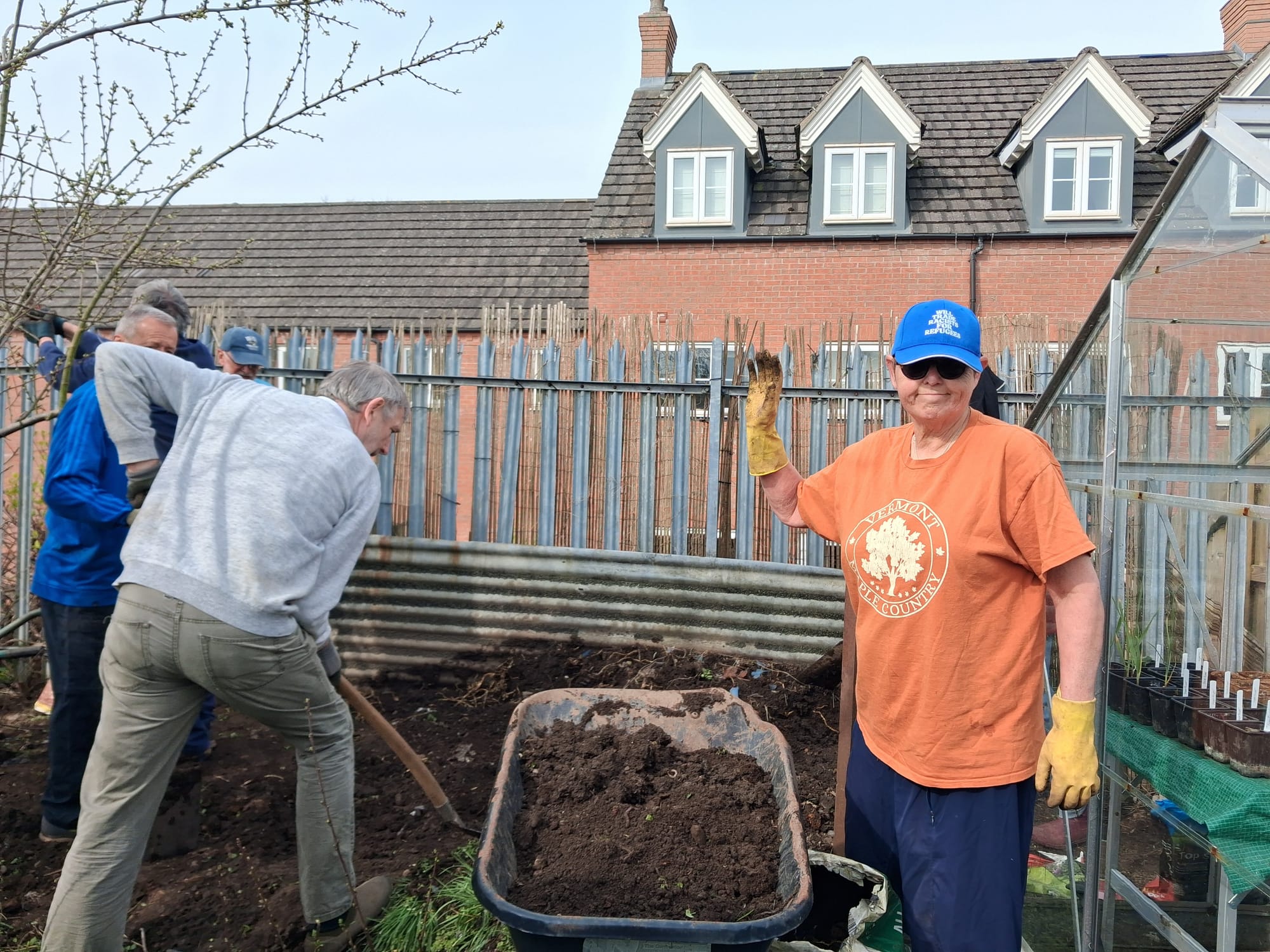
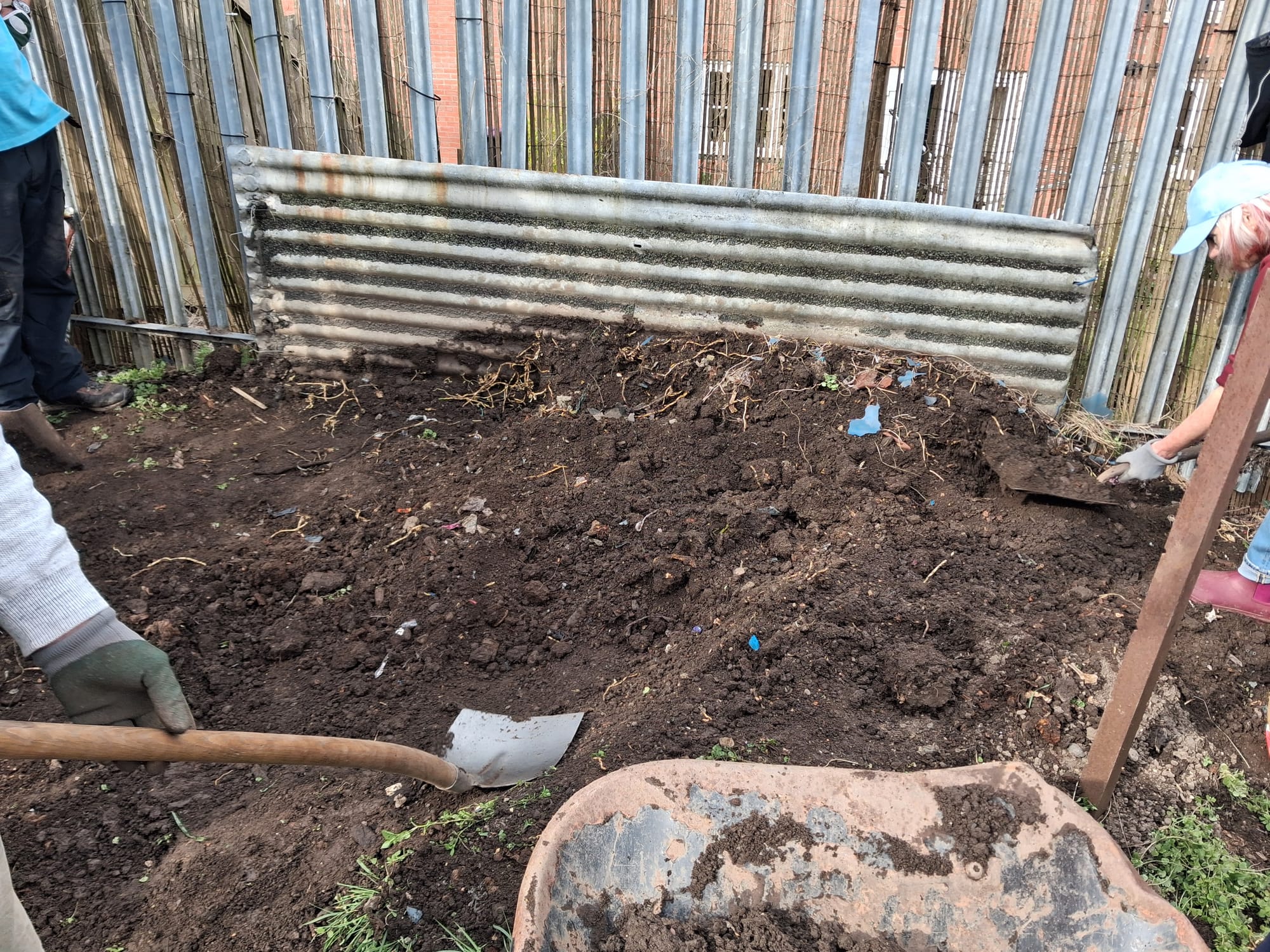
For some time now, we have been working hard to turn a redundant plot situated under a very large walnut tree, into a small wildlife space for insects and hedgehogs to live and thrive in relative peace, without the danger of encountering chemicals and gardening disturbance. Here are our first pictures of the progress we have made.
Sincere thanks go to Sheila Jones and Gareth Pike for all their hard work.